Who Represents Pa in the Us House of Representatives
The House of Representatives
The United States House of Representatives is one of the two houses of the United States Congress.
Learning Objectives
Discuss the organizational structure of the Business firm of Representatives and the qualifications for its members
Key Takeaways
Fundamental Points
- The major power of the House is to pass federal legislation that affects the entire land although its bills must as well be passed past the Senate and further agreed to by the U.South. President before becoming law.
- Each U.S. state is represented in the House in proportion to its population but is entitled to at least i representative. The about populous state, California, currently has 53 representatives.
- In some states, the Republican and Democratic parties cull their candidates for each district in their political conventions in spring or early summer, which often utilize unanimous voice votes to reflect either confidence in the incumbent or because of bargaining in before individual discussions.
- The Firm uses committees and their subcommittees for a multifariousness of purposes, including the review of bills and the oversight of the executive co-operative. The entire Business firm formally makes the appointment of committee members, just the choice of members is actually made by the political parties.
- The Constitution empowers the House of Representatives to impeach federal officials for treason, blackmail, or other loftier crimes and misdemeanors and empowers the Senate to try such impeachment.
Fundamental Terms
- impeachment: the human action of impeaching a public official, either elected or appointed, earlier a tribunal charged with determining the facts of the matter.
The Business firm of Representatives
Groundwork
The United States House of Representatives is one of the 2 houses of the U.s.a. Congress (bicameral legislature). It is frequently referred to every bit the House. The other house is the Senate.

US Congress in Present Times: Using Weber's theory of stratification, members of the U.Southward. Congress are at the meridian of the social hierarchy because they have high ability and status, despite having relatively little wealth on average.
The composition and powers of the House are established in Article one of the U.s. Constitution. The major ability of the House is to laissez passer federal legislation that affects the entire land although its bills must also be passed by the Senate and farther agreed to by the The states President earlier becoming constabulary (unless both the Firm and Senate re-pass the legislation with a ii-thirds majority in each sleeping accommodation). The House has several exclusive powers: the ability to initiate revenue bills, to impeach officials, and to elect the President in case there is no majority in the Balloter College.
Each U.Due south. state is represented in the Firm in proportion to its population but is entitled to at least one representative. The most populous state, California, currently has 53 representatives. Law fixes the total number of voting representatives at 435. Each representative serves for a two-year term. The Speaker of the United States House of Representatives, who presides over the sleeping room, is elected past the members of the Business firm, and is therefore traditionally the leader of the House Autonomous Conclave or the Business firm Republican Conference, whichever of the 2 Congressional Membership Organizations has more than (voting) members.
Apportionment
The population of U.S. Representatives is allocated to each of the 50 states and DC, ranked by population. DC (ranked l) receives no seats in the Firm. Under Article I, Section ii of the Constitution, population, as determined by the census conducted every ten years, apportions seats in the House of Representatives among the states. Each state, even so, is entitled to at to the lowest degree 1 Representative.
Qualifications
Article I, Section 2 of the Constitution sets 3 qualifications for representatives. Each representative must: (one) be at to the lowest degree xx-v years old; (2) have been a citizen of the Usa for the past 7 years; and (3) be (at the time of the election ) an inhabitant of the state they represent. Members are not required to alive in the district they represent, simply they traditionally do. The age and citizenship qualifications for representatives are less than those for senators. The constitutional requirements of Article I, Department 2 for election to Congress is the maximum requirements that can exist imposed on a candidate. Therefore, Article I, Section 5, which permits each House to exist the guess of the qualifications of its own members does not permit either House to establish additional qualifications. Likewise, a state could not establish additional qualifications.
Demographics
Congress is constantly changing, constantly in flux. In recent times, the American southward and westward accept gained House seats according to demographic changes recorded by the census and includes more minorities and women although both groups are still underrepresented, according to one view. While power balances among the different parts of regime continue to change, the internal construction of Congress is of import to understand forth with its interactions with so-called intermediary institutions such equally political parties, civic associations, interest groups, and the mass media.
Elections
Elections for representatives are held in every even-numbered year, on Election Day the first Tuesday subsequently the first Monday in November. Representatives must be elected from single-member districts by plurality voting.
In most states, major political party candidates for each district are nominated in partisan primary elections, typically held in spring to late summer. In some states, the Republican and Democratic parties choose their corresponding candidates for each district in their political conventions in spring or early on summer. They oft apply unanimous phonation votes to reflect either confidence in the incumbent or as the issue of bargaining in earlier private discussions.
Representatives and Delegates serve two-yr terms, while the Resident Commissioner serves for four years. The Constitution permits the House to miscarry a member with a ii-thirds vote. In the history of the U.s.a., only five members have been expelled from the Business firm.
The Senate
The Senate is composed of 2 senators from each land who are granted exclusive powers to confirm appointments and place holds on laws.
Learning Objectives
Summarize the powers accorded the Senate and the qualifications fix for Senators
Key Takeaways
Key Points
- The composition and powers of the Senate are established in Commodity One of the U.S. Constitution. 2 senators, regardless of population, represent each U.Due south. state. Senators serve staggered six-year terms.
- It has the power to consent to treaties as a precondition to their ratification and consenting or confirming appointments of Cabinet secretaries, federal judges, other federal executive officials, military officers, regulatory officials, ambassadors, and other federal uniformed officers.
- The Constitution stipulates that no constitutional amendment may be created to deprive a state of its equal suffrage in the Senate without that state's consent.
- Senators serve terms of six years each; the terms are staggered so that approximately one-third of the seats are up for election every two years.
- Senate process depends not merely on the rules, just also on a variety of customs and traditions. The Senate commonly waives some of its stricter rules past unanimous consent. Party leaders typically negotiate unanimous consent agreements beforehand.
Cardinal Terms
- cloture: In legislative assemblies that permit unlimited debate (delay); a motion, process or rule, by which contend is ended so that a vote may be taken on the matter. For case, in the United States Senate, a three-fifths majority vote of the trunk is required to invoke cloture and terminate debate.
- bicameral: Having, or pertaining to, two separate legislative chambers or houses.
Background
The United States Senate is the upper business firm of the bicameral legislature of the United States, and together with the United states Firm of Representatives comprises the Usa Congress. The composition and powers of the Senate are established in Commodity One of the U.South. Constitution. Two senators, regardless of population, represent each U.S. state. Senators serve staggered vi-year terms. The bedchamber of the United States Senate is located in the north wing of the Capitol, in Washington, D.C., the national upper-case letter.

Capitol-Senate: The Senate'southward side of the Capitol Building in Washington D.C.
The Senate has several sectional powers not granted to the House. These include the power to consent to treaties every bit a precondition to their ratification. The senate may too consent to or confirm the engagement of Cabinet secretaries, federal judges, other federal executive officials, war machine officers, regulatory officials, ambassadors, and other federal uniformed officers. The Senate is also responsible for trying federal officials impeached by the Business firm.
The Constitution stipulates that no constitutional amendment may be created to deprive a state of its equal suffrage in the Senate without that land'southward consent. The District of Columbia and all other territories (including territories, protectorates, etc. ) are non entitled to representation in either House of the Congress. The Commune of Columbia elects ii shadow senators, but they are officials of the D.C. metropolis government and not members of the U.South. Senate. The United States has had 50 states since 1959, thus the Senate has had 100 senators since 1959.
Qualifications
Commodity I, Section 3 of the Constitution sets three qualifications for senators: 1) they must be at least xxx years onetime, ii) they must accept been citizens of the United States for at least the by nine years, and 3) they must be inhabitants of the states they seek to represent at the fourth dimension of their ballot. The age and citizenship qualifications for senators are more stringent than those for representatives. In Federalist No. 62, James Madison justified this arrangement by arguing that the "senatorial trust" chosen for a "greater extent of information and stability of character. "
The Fourteenth Amendment to the United States Constitution disqualifies from the Senate any federal or state officers who had taken the requisite oath to support the Constitution, simply later on engaged in rebellion or aided the enemies of the United States. This provision, which came into strength shortly subsequently the end of the Civil State of war, was intended to prevent those who had sided with the Confederacy from serving.
Term and Elections
Senators serve terms of six years each. The terms are staggered so that approximately one-third of the seats are upwards for ballot every two years. This was achieved by dividing the senators of the 1st Congress into thirds (called classes), where the terms of one-tertiary expired afterwards two years, the terms of another tertiary expired after 4, and the terms of the last third expired after half dozen years. This arrangement was besides followed after the admission of new states into the union. The staggering of terms has been bundled such that both seats from a given country are not contested in the same general election, except when a mid-term vacancy is beingness filled. Current senators whose six-year terms expire on January 3, 2013, vest to Class I.
Daily Procedures
Senate procedure depends not simply on the rules, simply as well on a multifariousness of customs and traditions. The Senate usually waives some of its stricter rules by unanimous consent. Political party leaders typically negotiate unanimous consent agreements beforehand. A senator may cake such an understanding, but in practise, objections are rare. The presiding officer enforces the rules of the Senate, and may warn members who deviate from them. The presiding officer sometimes uses the gavel of the Senate to maintain order.
A "hold" is placed when the leader's office is notified that a senator intends to object to a request for unanimous consent from the Senate to consider or pass a mensurate. A agree may be placed for whatever reason and tin can be lifted by a senator at any time. A senator may identify a agree simply to review a bill, to negotiate changes to the bill, or to kill the pecker. A pecker can be held for equally long as the senator who objects to the bill wishes to block its consideration.
Holds tin can be overcome, merely require time-consuming procedures such as filing cloture. Holds are considered private communications between a senator and the Leader, and are sometimes referred to as "secret holds". A senator may disclose that he or she has placed a hold.
The House and the Senate: Differences in Responsibilities and Representation
The The states Congress is composed of the Business firm of Representatives and the Senate, which differ in representation, term length, power, and prestige.
Learning Objectives
Compare and contrast the structure and limerick of the House and Senate
Central Takeaways
Primal Points
- Congress is dissever into 2 chambers—the House of Representatives and Senate. Congress writes national legislation by dividing work into split up committees which specialize in unlike areas. Some members of Congress are elected past their peers to be officers of these committees.
- The disparity between the about and to the lowest degree populous states has grown since the Connecticut Compromise, which granted each land 2 members of the Senate and at to the lowest degree i member of the House of Representatives, for a total minimum of three presidential Electors, regardless of population.
- The Senate has several distinct powers. The "advice and consent " powers, such as the ability to corroborate treaties, are a sole Senate privilege. The House, however, can initiate spending bills and has exclusive authority to impeach officials and cull the President in an Electoral College deadlock.
- The Senate and House are farther differentiated past term lengths and the number of districts represented. With longer terms, fewer members and (in all but vii delegations) larger constituencies, senators may receive greater prestige.
Key Terms
- gerrymandering: The practice of redrawing electoral districts to proceeds an electoral advantage for a political party.
- circulation: It is the process of allocating the political power of a fix of elective voters among their representatives in a governing body.
Background
Congress is split into two chambers: the House of Representatives and the Senate. Congress writes national legislation by dividing work into separate committees which specialize in different areas. Some members of Congress are elected past their peers to be officers of these committees. Coincident organizations such as the Regime Accountability Office and the Library of Congress provide Congress with information, and members of Congress have staff and offices to assist them. Additionally, a vast industry of lobbyists helps members write legislation on behalf of diverse corporate and labor interests.
Senate Apportionment and Representation
The Constitution stipulates that no constitutional subpoena may be created to deprive a state of its equal suffrage in the Senate without that state's consent. The District of Columbia and all other territories (including territories, protectorates, etc.) are not entitled to representation in either House of the Congress. The Commune of Columbia elects two shadow senators, only they are officials of the D.C. city government and not members of the U.S. Senate. The U.s. has had 50 states since 1959, and then the Senate has had 100 senators since 1959.
The disparity between the most and least populous states has grown since the Connecticut Compromise, which granted each country ii members of the Senate and at to the lowest degree one member of the House of Representatives, for a total minimum of three presidential Electors, regardless of population. This means some citizens are effectively an order of magnitude meliorate represented in the Senate than those in other states. For example, in 1787, Virginia had roughly x times the population of Rhode Isle. Today, California has roughly seventy times the population of Wyoming, based on the 1790 and 2000 censuses. Seats in the Business firm of Representatives are approximately proportionate to the population of each state, reducing the disparity of representation.
House of Representatives Circulation and Representation
Under Commodity I, Section 2 of the Constitution, seats in the Business firm of Representatives are apportioned among the states past population, as determined by the census conducted every ten years. Each country, however, is entitled to at least one Representative.
The only constitutional rule relating to the size of the Business firm reads, "The Number of Representatives shall not exceed one for every 30 G. Congress regularly increased the size of the House to account for population growth until it fixed the number of voting House members at 435 in 1911. The number was temporarily increased to 437 in 1959 upon the admission of Alaska and Hawaii, seating 1 representative from each of those states without changing existing apportionment, and returned to 435 four years later, after the reapportionment consistent to the 1960 demography.
The Constitution does not provide for the representation of the District of Columbia or territories. The Commune of Columbia and the territories of American Samoa, Guam, the Northern Mariana Islands, and the U.S. Virgin Islands are represented past one non-voting delegate each. Puerto Rico elects a Resident Commissioner, merely other than having a four-twelvemonth term, the Resident Commissioner'southward role is identical to the delegates from the other territories. The five Delegates and Resident Commissioner may participate in debates. Prior to 2011, they were besides allowed to vote in committees and the Committee of the Whole when their votes would not be decisive.
States that are entitled to more than than one Representative are divided into unmarried-member districts. This has been a federal statutory requirement since 1967. Prior to that police force, full general ticket representation was used by some states. Typically, states redraw these district lines afterwards each census, though they may do and so at other times. Each state determines its own district boundaries, either through legislation or through non- partisan panels. Disproportion in representatives is unconstitutional and districts must be approximately equal in. The Voting Rights Act prohibits states from gerrymandering districts.

Gerrymandering Comparison: In this example, the more even distribution is on the left and the gerrymandered distribution is on the right.
Comparison to the Senate
As a bank check on the popularly elected Firm, the Senate has several distinct powers. For instance, the "communication and consent" powers are a sole Senate privilege. The Business firm, however, tin initiate spending bills and has sectional authority to impeach officials and choose the President in an Electoral Higher deadlock. The Senate and Business firm are further differentiated by term lengths and the number of districts represented. Different the Senate, the Business firm is more than hierarchically organized, with leadership roles such as the Whips and the Minority and Majority leaders playing a bigger office. Moreover, the process of the House depends not only on the rules, just also on a diversity of community, precedents, and traditions. In many cases, the Business firm waives some of its stricter rules (including time limits on debates) by unanimous consent. With longer terms, fewer members and (in all but 7 delegations) larger constituencies, senators may receive greater prestige. The Senate has traditionally been considered a less partisan chamber because it's relatively minor membership might have a improve hazard to broker compromises.
The Legislative Part
The House and Senate are equal partners in the legislative process; legislation cannot exist enacted without the consent of both chambers.
Learning Objectives
Differentiate between the powers granted by the Constitution to the House and Senate
Primal Takeaways
Primal Points
- Commodity I of the Constitution states all legislative powers herein granted shall be vested in a Congress of the United States, which shall consist of a Senate and a Business firm of Representatives. Both are equal partners in the legislative process; legislation can't be enacted without both their consent.
- Congress has implied powers deriving from the Constitution'south Necessary and Proper Clause which permit Congress to "make all laws which shall be necessary and proper for conveying into execution the foregoing powers, and all other powers vested past this Constitution…".
- Legislative, oversight, and internal authoritative tasks are divided amid well-nigh two hundred committees and subcommittees which gather information, evaluate alternatives, and place problems.
Cardinal Terms
- Necessary and Proper Clause: the provision in Commodity One of the Usa Constitution, section 8, clause 18, which states that Congress has the power "to brand all Laws which shall be necessary and proper" for executing its duties
- bypass: It is to avoid an obstacle etc, by constructing or using a bypass.
- legislative: That co-operative of government which is responsible for making, or having the ability to make, a law or laws.
Groundwork
Article I of the Constitution states all legislative powers herein granted shall be vested in a Congress of the United States, which shall consist of a Senate and a Business firm of Representatives. The House and Senate are equal partners in the legislative process—legislation cannot be enacted without the consent of both chambers. Even so, the Constitution grants each chamber some unique powers. The Senate ratifies treaties and approves presidential appointments while the House initiates revenue-raising bills. The House initiates impeachment cases, while the Senate decides impeachment cases. A two-thirds vote of the Senate is required before an impeached person can exist forcibly removed from function.
Congress has implied powers deriving from the Constitution's Necessary and Proper Clause which permit Congress to "make all laws which shall be necessary and proper for carrying into execution the foregoing powers, and all other powers vested past this Constitution in the authorities of the United States, or in whatever department or officeholder thereof. " Broad interpretations of this clause and of the Commerce Clause, the enumerated power to regulate commerce, in rulings such as McCulloch five Maryland have effectively widened the telescopic of Congress's legislative say-so far beyond that prescribed in Section 8.
Congress Overseeing the Executive Co-operative
Ane of Congress's foremost non-legislative functions is the power to investigate and oversee the executive branch. Congressional oversight is usually delegated to committees and is facilitated by Congress's subpoena power. Some critics have charged that Congress has, in some instances, failed to do an adequate job of overseeing the other branches of authorities. In the Plame affair, critics, including Representative Henry A. Waxman, charged that Congress was not doing an acceptable job of oversight in this case. There have been concerns about congressional oversight of executive deportment such as warrantless wiretapping, although others answer that Congress did investigate the legality of presidential decisions.
Congress also has the sectional power of removal, allowing impeachment and removal of the president, federal judges and other federal officers. At that place accept been charges that presidents acting nether the doctrine of the unitary executive take assumed of import legislative and monetary powers that should belong to Congress. So-called 'signing statements' are one mode in which a president can "tip the balance of power betwixt Congress and the White House a little more in favor of the executive branch," co-ordinate to one account. By presidents, including Ronald Reagan, George H. W. Bush, Bill Clinton, and George W. Bush have made public statements when signing congressional legislation almost how they empathize a bill or plan to execute it, and commentators including the American Bar Association have described this practice as against the spirit of the Constitution. At that place accept been concerns that presidential authority to cope with financial crises is eclipsing the power of Congress
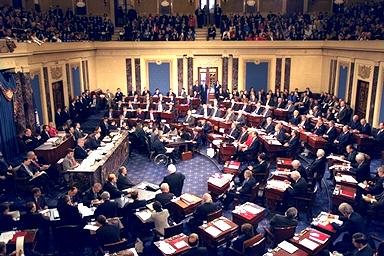
The impeachment trial of President Clinton: Floor proceedings of the U.S. Senate, in session during the impeachment trial of Neb Clinton.
Power in Committees
Committees write legislation. While procedures such as the House discharge petition procedure can innovate bills to the Firm floor and effectively featherbed committee input, they are exceedingly difficult to implement without committee action. Committees have power and have been chosen ' independent fiefdoms'. Legislative, oversight, and internal administrative tasks are divided among about 2 hundred committees and subcommittees which assemble information, evaluate alternatives, and place problems. They propose solutions for consideration by the full chamber. They also perform the office of oversight past monitoring the executive branch and investigating wrongdoing.
Bills and resolutions
In social club to form a bill or resolution, first the Firm Financial Services committee meets. Commission members sit in the tiers of raised chairs, while those testifying and audience members sit down beneath. Ideas for legislation can come up from members, lobbyists, state legislatures, constituents, legislative counsel, or executive agencies. Usually, the next step is for the proposal to be passed to a commission for review. A submitted proposal usually takes ane of the following forms:
- A bill, which is a law in the making.
- A joint resolution, which differs little from a beak since both are treated similarly. However, a joint resolution originates from the House.
- A Concurrent Resolutions, which affects both Business firm and Senate and thus are not presented to the president for blessing later.
- Simple resolutions, which business organisation just the Firm or only the Senate.
The Representation Function
A compromise plan was adopted where representatives were chosen past the population and 2 senators were chosen past country governments.
Learning Objectives
Describe the outcome of the Connecticut Compromise
Central Takeaways
Key Points
- Since 1787, the population disparity between large and modest states has grown. For example, in 2006 California had 70 times the population of Wyoming.
- Critics, such as constitutional scholar Sanford Levinson, have suggested that the population disparity works against residents of large states and causes a steady redistribution of resources from large states to small states.
- The Connecticut Compromise gave every state, large and small, an equal vote in the Senate. Since each state has two senators, residents of smaller states have more clout in the Senate than residents of larger states.
- Providing services helps members of Congress win votes because elections tin can brand a difference in close races. Congressional staff tin help citizens navigate government bureaucracies.
Fundamental Terms
- framers: The authors of the American Constitution.
- cloakroom: A room, in a public building such as a theatre, where coats and other belongings may be left temporarily.
Background
The two-chamber construction had functioned well in country governments. A compromise program was adopted and representatives were called past the population which benefited larger states. 2 senators were chosen past country governments which benefited smaller states.
When the Constitution was ratified in 1787, the ratio of the populations of large states to pocket-size states was roughly 12 to ane. The Connecticut Compromise gave every state, large and small, an equal vote in the Senate. Since each land has ii senators, residents of smaller states accept more clout in the Senate than residents of larger states. Still, since 1787, the population disparity between large and small states has grown. For example, in 2006 California had seventy times the population of Wyoming.

Congress Hall Committee Room in Philadelphia: The second committee room upstairs in Congress Hall, Philadelphia, PA.
Critics, such as constitutional scholar Sanford Levinson, take suggested that the population disparity works against residents of large states and causes a steady redistribution of resources from large states to small states. Notwithstanding, others debate that the framers intended for the Connecticut Compromise to construct the Senate so that each state had equal ground that was not based on population. Critics contend that the upshot is successful for maintaining residual.
Members and Constituents
A major role for members of Congress is providing services to constituents. Constituents request help with issues. Providing services helps members of Congress win votes because elections can make a divergence in close races. Congressional staff can help citizens navigate government bureaucracies. Ane academic described the complex intertwined relation between lawmakers and constituents as "home mode. "
Congressional Style
According to political scientist Richard Fenno, there are specific ways to categorize lawmakers. Start, is if they are generally motivated past reelection: these are lawmakers who never met a voter they did not like and provide excellent constituent services. Second, is if they have adept public policy: these are legislators who burnish a reputation for policy expertise and leadership. Third, is if they have power in the chamber: these are lawmakers who spend serious time along the rail of the House floor or in the Senate cloakroom ministering to the needs of their colleagues.
Service to Constituents
A major part for members of Congress is providing services to constituents.
Learning Objectives
Summarize the services Congresspersons and their staff provide constituents
Key Takeaways
Key Points
- A major office for members of Congress is providing services to constituents. Constituents asking help with bug. Providing services helps members of Congress win votes and elections and can make a departure in close races.
- The member'south constituency, important regional issues, prior groundwork and experience may influence the choice of specialty. Senators often choose a different specialty from that of the other senator from their country to forbid overlap.
- Senators often choose a different specialty from that of the other senator from their state to prevent overlap. Some committees specialize in running the concern of other committees and exert a powerful influence over all legislation.
Key Terms
- constituency: An involvement group or fan base.
Background
A major role for members of Congress is providing services to constituents. Constituents request assistance with issues. Providing services helps members of Congress win votes and elections and can make a difference in close races. Congressional staff can assistance citizens navigate regime bureaucracies. Ane academic described the complex intertwined relationship between lawmakers and constituents every bit "abode style. "
Committees investigate specialized subjects and propose the entire Congress about choices and trade-offs. The member'due south constituency, of import regional issues, and prior background and feel may influence the choice of specialty. Senators ofttimes choose a different specialty from that of the other senator from their country to prevent overlap. Some committees specialize in running the business of other committees and exert a powerful influence over all legislation; for case, the House Ways and Means Committee take considerable influence over House affairs.

2004 Presidential Election by County: This map shows the vote in the 2004 presidential election by canton. All major Republican geographic constituencies are visible: red dominates the map, showing Republican strength in the rural areas, while the denser areas (i.e., cities) are blueish. Notable exceptions include the Pacific declension; New England; the Black Chugalug, areas with high Native American populations; and the heavily Hispanic parts of the Southwest.
Congressional Mode
One way to categorize lawmakers, according to political scientist Richard Fenno, is by their full general motivation:
- re-election, these are lawmakers who "never met a voter they did not like" and provide fantabulous elective services
- practiced public policy, legislators who burnish a reputation for policy expertise and leadership
- ability in the chamber, lawmakers who spend serious time along the rail of the House floor or in the Senate cloakroom ministering to the needs of their colleagues – famous legislator Henry Clay in the mid-nineteenth century was described as an "issue entrepreneur" who looked for issues to serve his ambitions
- gridlock, unless Congress tin can begin to work together through compromise, each fellow member will be removed, by one means or another (i.e., past CPA).
The Oversight Function
The United States Congress has oversight of the Executive Branch and other U.South. federal agencies.
Learning Objectives
Describe congressional oversight and the varied bases whence its authority is derived
Key Takeaways
Key Points
- Congressional oversight is the review, monitoring, and supervision of federal agencies, programs, activities, and policy implementation.
- Congress exercises this power largely through its congressional committee system. Even so, oversight, which dates to the earliest days of the Republic, too occurs in a wide variety of congressional activities and contexts.
- It is implied in the legislature 's potency, among other powers and duties, to appropriate funds, enact laws, raise and support armies, provide for a Navy, declare war, and impeach and remove from function the President, Vice President, and other civil officers.
Primal Terms
- subpoena: A writ requiring someone to appear in court to requite testimony.
Groundwork
Congressional oversight refers to oversight by the U.s. Congress of the Executive Branch, including the numerous U.Due south. federal agencies. Congressional oversight is the review, monitoring, and supervision of federal agencies, programs, activities, and policy implementation. Congress exercises this power largely through its congressional committee organization. However, oversight, which dates to the earliest days of the Republic, likewise occurs in a wide variety of congressional activities and contexts. These include authorization, appropriations, investigative, and legislative hearings past standing committees; specialized investigations by select committees; and reviews and studies by congressional support agencies and staff.
Congress's oversight potency derives from its "implied" powers in the Constitution, public laws, and House and Senate rules. Information technology is an integral part of the American system of checks and balances.
Study on the Organization of Congress
Oversight is an implied rather than an enumerated power under the U.South. Constitution. The government 's charter does not explicitly grant Congress the authority to carry inquiries or investigations of the executive, to accept access to records or materials held by the executive, or to upshot subpoenas for documents or testimony from the executive.
There was little give-and-take of the ability to oversee, review, or investigate executive activity at the Ramble Convention of 1787 or later in the Federalist Papers, which argued in favor of ratification of the Constitution. The lack of contend was because oversight and its attendant say-so were seen as an inherent power of representative assemblies, which enacted public police.
Oversight likewise derives from the many, varied express powers of the Congress in the Constitution. It is implied in the legislature'south authority, amongst other powers and duties, to advisable funds, enact laws, heighten and support armies, provide for a Navy, declare war, and impeach and remove from office the President, Vice President, and other ceremonious officers. Congress could non reasonably or responsibly practice these powers without knowing what the executive was doing; how programs were being administered, by whom, and at what cost; and whether officials were obeying the police force and complying with legislative intent.
The Supreme Court of the United states of america fabricated the oversight powers of Congress legitimate, bailiwick to constitutional safeguards for civil liberties, on several occasions. For instance, in 1927 the High Court institute that in investigating the administration of the Justice Department, Congress was considering a bailiwick "on which legislation could exist had or would be materially aided by the data which the investigation was calculated to elicit. "
Activities and Avenues
Oversight occurs through a wide diversity of congressional activities and avenues. Some of the most publicized are the comparatively rare investigations by select committees into major scandals or executive co-operative operations gone awry. Examples are temporary select commission inquiries into: China'south acquisition of U.Southward. nuclear weapons data, in 1999; the Iran-Contra matter, in 1987; intelligence bureau abuses, in 1975-1976, and "Watergate," in 1973-1974. The precedent for this kind of oversight goes back ii centuries: in 1792, a special House committee investigated the defeat of an Regular army forcefulness past confederated Indian tribes.

Jim Greenwood Commission Chair: Congressman Jim Greenwood, Chairman of the Business firm Commission on Energy and Commerce Subcommittee on Oversight and Investigations, gavels to beginning the hearing on human being cloning.
The Public-Education Function of Congress
The Library of Congress provides public information and educates the public virtually legislation among other general information.
Learning Objectives
Give examples of the various roles the Library Congress plays in public education
Primal Takeaways
Primal Points
- Putnam focused his efforts on making the Library more attainable and useful for the public and for other libraries. He instituted the interlibrary loan service, transforming the Library of Congress into what he referred to every bit a "library of concluding resort".
- Based in the Progressive era 'south philosophy of scientific discipline as a trouble-solver, and modeled after successful enquiry branches of country legislatures, the LRS would provide informed answers to Congressional research inquiries on almost any topic.
- The library is open to the general public for bookish inquiry and tourists. But those who are issued a Reader Identification Card may enter the reading rooms and access the drove.
Primal Terms
- endowment: The invested funds of a not-for-profit institution.
Background
The Library of Congress, spurred by the 1897 reorganization, began to grow and develop more than quickly. Herbert Putnam held the office for xl years from 1899 to 1939, inbound into the position two years before the Library became the first in the United States to hold ane meg volumes. Putnam focused his efforts on making the Library more accessible and useful for the public and for other libraries. He instituted the interlibrary loan service, transforming the Library of Congress into what he referred to as a library of last resort. Putnam also expanded Library admission to "scientific investigators and duly qualified individuals" and began publishing main sources for the benefit of scholars.

Library of Congress: The collections of the Library of Congress include more than 32 one thousand thousand cataloged books and other print materials in 470 languages; more than 61 million manuscripts.
Putnam's tenure also saw increasing diversity in the Library'southward acquisitions. In 1903, he persuaded President Theodore Roosevelt to transfer by executive lodge the papers of the Founding Fathers from the State Department to the Library of Congress. Putnam expanded foreign acquisitions also.
In 1914, Putnam established the Legislative Reference Service as a separative administrative unit of the Library. Based in the Progressive era's philosophy of scientific discipline as a problem-solver, and modeled afterwards successful research branches of state legislatures, the LRS would provide informed answers to Congressional research inquiries on almost any topic. In 1965, Congress passed an human activity allowing the Library of Congress to establish a trust fund board to accept donations and endowments, giving the Library a role as a patron of the arts.
The Library received the donations and endowments of prominent individuals such as John D. Rockefeller, James B. Wilbur and Archer Yard. Huntington. Gertrude Clarke Whittall donated five Stradivarius violins to the Library and Elizabeth Sprague Coolidge'south donations paid for a concert hall within the Library of Congress building and the establishment of an honorarium for the Music Division. A number of chairs and consultantships were established from the donations, the best known of which is the Poet Laureate Consultant.
Library of Congress Expansion
The Library's expansion eventually filled the Library'south Main Edifice, despite shelving expansions in 1910 and 1927, forcing the Library to expand into a new structure. Congress acquired nearby land in 1928 and approved construction of the Annex Building (after the John Adams Building) in 1930. Although delayed during the Depression years, it was completed in 1938 and opened to the public in 1939.
When Putnam retired in 1939, President Franklin D. Roosevelt appointed Archibald MacLeish every bit his successor. Occupying the post from 1939 to 1944 during the height of World State of war Two, MacLeish became the virtually visible Librarian of Congress in the Library's history. MacLeish encouraged librarians to oppose totalitarianism on behalf of democracy; dedicated the South Reading Room of the Adams Building to Thomas Jefferson, commissioning artist Ezra Winter to paint 4 themed murals for the room; and established a "democracy alcove" in the Main Reading Room of the Jefferson Building for of import documents such as the Declaration, Constitution and Federalist Papers.
Even the Library of Congress assisted during the war endeavor. These efforts ranged from the storage of the Announcement of Independence and the United States Constitution in Fort Knox for safekeeping to researching weather data on the Himalayas for Air Force pilots. MacLeish resigned in 1944 to become Assistant Secretary of State, and President Harry Truman appointed Luther H. Evans as Librarian of Congress. Evans, who served until 1953, expanded the Library's acquisitions, cataloging and bibliographic services as much as the financial-minded Congress would allow, but his primary achievement was the creation of Library of Congress Missions around the world. Missions played a multifariousness of roles in the postwar earth: the mission in San Francisco assisted participants in the meeting that established the United Nations, the mission in Europe caused European publications for the Library of Congress and other American libraries, and the mission in Japan aided in the cosmos of the National Nutrition Library.
In 2016, Dr. Carla Hayden was appointed as the 14th Librarian of Congress, the first adult female, and the kickoff African-American to serve in the position.The library is open to the general public for academic research and tourists. Only those who are issued a Reader Identification Card may enter the reading rooms and access the collection. The Reader Identification Carte is bachelor in the Madison building to persons who are at least sixteen years of age upon presentation of a government issued picture show identification (e.grand. commuter's license, state ID card or passport). Nevertheless, only members of Congress, Supreme Court Justices, their staff, Library of Congress staff and certain other authorities officials may actually remove items from the library buildings. Members of the general public with Reader Identification Cards must use items from the library drove within the reading rooms only. Since 1902, libraries in the United states of america accept been able to asking books and other items through interlibrary loan from the Library of Congress if these items are not readily available elsewhere.
The Conflict-Resolution Office
Both the Senate and the House take a conflict-resolution procedure earlier a nib is passed as a piece of legislation.
Learning Objectives
Summarize the steps by which a bill becomes law
Central Takeaways
Key Points
- Representatives innovate a bill while the House is in session by placing it in the hopper on the Clerk's desk. It is assigned a number and referred to a commission. The committee studies each pecker intensely at this stage.
- Each pecker goes through several stages in each firm including consideration by a commission and advice from the Government Accountability Office. Most legislation is considered by standing committees, which take jurisdiction over a item subject field such as Agriculture or Appropriations.
- Once a bill is canonical past one house, it is sent to the other house which may pass, refuse, or amend it. For the bill to become constabulary, both houses must concord to identical versions of the bill.
- Afterward passing through both houses, a bill is sent to the president for approval. The president may sign it making it law or veto it and return it to Congress with his objections. A vetoed bill tin can still become law if each house of Congress votes to override the veto with a two-thirds bulk.
- If Congress is adjourned during this menstruation, the president may veto legislation passed at the end of a congressional session simply by ignoring it. This maneuver is known every bit a pocket veto. It cannot be overridden by the adjourned Congress.
Key Terms
- appropriation: Public funds set aside for a specific purpose.
- amend: To make a formal alteration in legislation by adding, deleting, or rephrasing.
Background
Representatives innovate a bill while the Business firm is in session by placing it in the hopper on the Clerk's desk. It is assigned a number and referred to a committee. At this stage, the commission studies each bill intensely. Drafting statutes requires "smashing skill, knowledge, and experience" and can sometimes take a year or more. On occasion, lobbyists write legislation and submit it to a member for introduction. Joint resolutions are the normal fashion to propose a constitutional amendment or declare war. On the other hand, concurrent resolutions (passed by both houses) and elementary resolutions (passed by only one house) practice not have the strength of police force, but they express the opinion of Congress or regulate procedure. Any member of either house may introduce bills. However, the Constitution provides states that: All bills for raising Revenue shall originate in the House of Representatives. While the Senate cannot originate revenue and cribbing bills, it has the power to amend or turn down them. Congress has sought ways to establish advisable spending levels.
Pecker and Resolutions
Each neb goes through several stages in each firm including consideration by a commission and advice from the Government Accountability Office. Nearly legislation is taken into consideration by standing committees, which have jurisdiction over a particular field of study such as Agriculture or Appropriations. The House has 20 continuing committees; the Senate has xvi. Standing committees meet at least once each calendar month. Almost all standing commission meetings for transacting business must be open to the public unless the committee publicly votes to close the meeting. A committee might call for public hearings on important bills. A chair who belongs to the majority political party and a ranking fellow member of the minority political party lead each commission. Witnesses and experts can present their example for or confronting a nib. Then, a bill may go to what is called a marking-up session where commission members argue the bill's claim. The committee members may offer amendments or revisions. Committees may also amend the bill, only the full business firm holds the power to accept or reject committee amendments. After debate, the committee votes whether it wishes to written report the mensurate to the full house. If a bill is tabled, then it is rejected. If amendments are extensive, sometimes a new pecker with amendments congenital in will be submitted equally a so-called "clean bill" with a new number. Generally, members who have been in Congress longer have greater seniority and therefore greater power.

U.Southward. Business firm Committee: The House Fiscal Services Committee meets. Committee members sit in the tiers of raised chairs, while individuals testifying and audition members sit below.
A bill, that reaches the floor of the full house, can be simple or complex. It begins with an enacting formula such equally "Be information technology enacted by the Senate and House of Representatives of the United States of America in Congress assembled. " Consideration of a beak requires, itself, a rule which is a simple resolution specifying the particulars of debate—time limits, possibility of further amendments, and such. Each side has equal time and members tin can yield to other members who wish to speak. Sometimes opponents seek to recommit a bill, which ways to alter role of information technology. Generally, discussion requires a quorum, usually half of the total number of representatives, earlier discussion tin can begin, although there are exceptions. The firm may fence and better the bill. The precise procedure used by the Firm and Senate differs. A last vote on the bill follows.
Once a neb is approved by i house, it is sent to the other which may pass, reject, or amend it. For the bill to become law, both houses must agree to identical versions of the pecker. If the second business firm amends the bill, then the differences between the two versions must exist reconciled in a briefing committee. This is an ad hoc committee that includes both senators and representatives and uses a reconciliation process to limit budget bills. Both Houses use a budget enforcement mechanism informally known as "pay-every bit-y'all-go" or "pay-go" which discourages members from considering acts which increase budget deficits. If both houses agree to the version reported by the conference committee, the bill passes, otherwise information technology fails.
The Constitution, notwithstanding, requires a recorded vote if demanded past one-5th of the members nowadays. If the vocalisation vote is unclear or if the matter is controversial, a recorded vote usually happens.
After passage by both houses, a bill is enrolled and sent to the president for approval. The president may sign it making information technology law. If the neb is vetoed, the president returns it to Congress with his objections. A vetoed bill can still become law if each business firm of Congress votes to override the veto with a two-thirds majority. However, if Congress is adjourned during this period, the president may veto legislation passed at the finish of a congressional session merely by ignoring it. This maneuver is known equally a pocket veto. It cannot be overridden past the adjourned Congress.
Source: https://courses.lumenlearning.com/boundless-politicalscience/chapter/the-nature-and-function-of-congress/
0 Response to "Who Represents Pa in the Us House of Representatives"
إرسال تعليق