Show Borel Measure of a Closed Ball is Upper Semi Continuous
In mathematics, specifically in measure theory, a Borel measure on a topological space is a measure that is defined on all open sets (and thus on all Borel sets).[1] Some authors require additional restrictions on the measure, as described below.
Formal definition [edit]
Let be a locally compact Hausdorff space, and let be the smallest σ-algebra that contains the open sets of ; this is known as the σ-algebra of Borel sets. A Borel measure is any measure defined on the σ-algebra of Borel sets.[2] A few authors require in addition that is locally finite, meaning that for every compact set . If a Borel measure is both inner regular and outer regular, it is called a regular Borel measure. If is both inner regular, outer regular, and locally finite, it is called a Radon measure.


On the real line [edit]
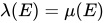
The real line with its usual topology is a locally compact Hausdorff space, hence we can define a Borel measure on it. In this case, is the smallest σ-algebra that contains the open intervals of . While there are many Borel measures μ, the choice of Borel measure that assigns for every half-open interval is sometimes called "the" Borel measure on . This measure turns out to be the restriction to the Borel σ-algebra of the Lebesgue measure , which is a complete measure and is defined on the Lebesgue σ-algebra. The Lebesgue σ-algebra is actually the completion of the Borel σ-algebra, which means that it is the smallest σ-algebra that contains all the Borel sets and has a complete measure on it. Also, the Borel measure and the Lebesgue measure coincide on the Borel sets (i.e., for every Borel measurable set, where is the Borel measure described above).


![{\displaystyle \mu ((a,b])=b-a}](https://wikimedia.org/api/rest_v1/media/math/render/svg/f70e3772fedcc01a404e06e8ff684241ee7f9979)
![(a,b]](https://wikimedia.org/api/rest_v1/media/math/render/svg/6a6969e731af335df071e247ee7fb331cd1a57ae)

Product spaces [edit]
If X and Y are second-countable, Hausdorff topological spaces, then the set of Borel subsets of their product coincides with the product of the sets of Borel subsets of X and Y.[3] That is, the Borel functor

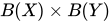

from the category of second-countable Hausdorff spaces to the category of measurable spaces preserves finite products.
Applications [edit]
Lebesgue–Stieltjes integral [edit]
The Lebesgue–Stieltjes integral is the ordinary Lebesgue integral with respect to a measure known as the Lebesgue–Stieltjes measure, which may be associated to any function of bounded variation on the real line. The Lebesgue–Stieltjes measure is a regular Borel measure, and conversely every regular Borel measure on the real line is of this kind.[4]
Laplace transform [edit]
One can define the Laplace transform of a finite Borel measure μ on the real line by the Lebesgue integral[5]
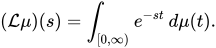
An important special case is where μ is a probability measure or, even more specifically, the Dirac delta function. In operational calculus, the Laplace transform of a measure is often treated as though the measure came from a distribution function f. In that case, to avoid potential confusion, one often writes
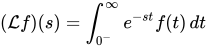
where the lower limit of 0− is shorthand notation for

This limit emphasizes that any point mass located at 0 is entirely captured by the Laplace transform. Although with the Lebesgue integral, it is not necessary to take such a limit, it does appear more naturally in connection with the Laplace–Stieltjes transform.
Hausdorff dimension and Frostman's lemma [edit]
Given a Borel measure μ on a metric space X such that μ(X) > 0 and μ(B(x, r)) ≤ rs holds for some constant s > 0 and for every ball B(x, r) in X, then the Hausdorff dimension dimHaus(X) ≥ s. A partial converse is provided by the Frostman lemma:[6]
Lemma: Let A be a Borel subset of R n , and let s > 0. Then the following are equivalent:
- H s (A) > 0, where H s denotes the s-dimensional Hausdorff measure.
- There is an (unsigned) Borel measure μ satisfying μ(A) > 0, and such that
-
- holds for all x ∈R n and r > 0.

Cramér–Wold theorem [edit]
The Cramér–Wold theorem in measure theory states that a Borel probability measure on is uniquely determined by the totality of its one-dimensional projections.[7] It is used as a method for proving joint convergence results. The theorem is named after Harald Cramér and Herman Ole Andreas Wold.

References [edit]
- ^ D. H. Fremlin, 2000. Measure Theory Archived 2010-11-01 at the Wayback Machine. Torres Fremlin.
- ^ Alan J. Weir (1974). General integration and measure. Cambridge University Press. pp. 158–184. ISBN0-521-29715-X.
- ^ Vladimir I. Bogachev. Measure Theory, Volume 1. Springer Science & Business Media, Jan 15, 2007
- ^ Halmos, Paul R. (1974), Measure Theory , Berlin, New York: Springer-Verlag, ISBN978-0-387-90088-9
- ^ Feller 1971, §XIII.1
- ^ Rogers, C. A. (1998). Hausdorff measures. Cambridge Mathematical Library (Third ed.). Cambridge: Cambridge University Press. pp. xxx+195. ISBN0-521-62491-6.
- ^ K. Stromberg, 1994. Probability Theory for Analysts. Chapman and Hall.
Further reading [edit]
- Gaussian measure, a finite-dimensional Borel measure
- Feller, William (1971), An introduction to probability theory and its applications. Vol. II., Second edition, New York: John Wiley & Sons, MR 0270403 .
- J. D. Pryce (1973). Basic methods of functional analysis. Hutchinson University Library. Hutchinson. p. 217. ISBN0-09-113411-0.
- Ransford, Thomas (1995). Potential theory in the complex plane. London Mathematical Society Student Texts. Vol. 28. Cambridge: Cambridge University Press. pp. 209–218. ISBN0-521-46654-7. Zbl 0828.31001.
- Teschl, Gerald, Topics in Real and Functional Analysis, (lecture notes)
- Wiener's lemma related
External links [edit]
- Borel measure at Encyclopedia of Mathematics
Source: https://en.wikipedia.org/wiki/Borel_measure
0 Response to "Show Borel Measure of a Closed Ball is Upper Semi Continuous"
إرسال تعليق