When Did South Sudan Army Start Using Child Soldiers Again
UN investigators have warned that despite the delicate peace in South Sudan, the recruitment of children into the army and militias is on the increase equally each side seeks to bolster infantry numbers.
The investigators also warned that sexual violence against women and localised ethnic violence are increasing tensions that could return the land to civil state of war.
"What our investigators accept picked upwardly is that in many of the hotspots you are actually seeing an increase in child soldiers," said Yasmin Sooka, chair of the Un Commission on Man Rights in South Sudan.
Sooka added that among those recruited were girls who were were being forced to provide sex activity and labour services to fighters.
In her accost to the UN Human being Rights Council on Monday, Sooka, who visited the country last month, delivered a clear warning that she identified ascension tension in the region, causing concern for the future safety, security and stability of South Sudan'due south children.
"Ironically, the prospect of a peace bargain has accelerated the forced recruitment of children, with various groups at present seeking to heave their numbers before they move into the cantonment sites," she said.
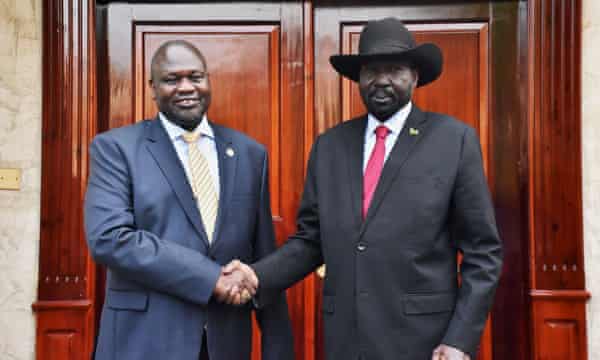
Commenting on the agreement to form a transitional government by mid-November, signed by President Salva Kiir and rebel leader Riek Machar concluding week, Sooka warned that the cosmos of a joint regular army could in itself encourage the recruitment of children, as young fighters looked for handouts.
"Once the selection procedure takes place for the unified army, the remaining ones who are not selected will be demobilised through the national disarmament, demobilization and reintegration committee (NDDRC) procedure, and so the incentives of beingness able to access [the] package may be an incentive to nifty the numbers."
Sooka's comments point to two areas of concern: an increase in child soldiers who could transition to forces outside the regime's control, and the wider hazard of a render to civil war. Using the central Jur River region as an example, where there have been 30 local incidents and so far this year, Sooka highlighted her concerns about a possible revival of the broader conflict, fuelled past local flare-ups involving tit-for-tat cattle raids driven past ethnic tensions.
"I recall in a country where the state doesn't have control of vast parts of the region, if this thing [localised violence] doesn't go downwardly … y'all have the potential to run across fighting breaking out in and so many parts of the land," she said.
Sooka's remarks are supported past UN reports of internal conflict in isolated areas controlled by both sides. In July, the Un reported that South Sudan's army and other armed militia groups had killed more than than 100 civilians in a surge in violence in the southern region of the state. In some other study published the same month, a UN peacekeeping mission revealed that, between September 2022 and April 2019, sexual violence continued to occur in the Primal Equatoria region. This included the rape of an estimated 100 women and girls.
Following five years of ceremonious state of war and unrest that claimed about 400,000 lives, the government of Due south Sudan and rebel groups reached a peace deal in 2018. This included an agreement to release thousands of kid soldiers and others drawn into the conflict.
Often removed from their parents at gunpoint during raids, boys and girls – some as young as 10 – are forced to go soldiers. Armed with set on rifles and trained to kill, some accept get as ruthless every bit the adults they fight aslope, as they themselves fight for their own survival.
According to the UN, Due south Sudan is not alone. In 2018, their enquiry identified 14 countries which they say are guilty of recruiting and using children in conflict: Afghanistan, Cardinal African Commonwealth, Colombia, the Democratic Republic of the Congo, Iraq, Mali, Myanmar, Nigeria, Philippines, Somalia, South Sudan, Sudan, Syrian arab republic and Republic of yemen. Globally it is estimated that there are up to 250,000 child soldiers, twoscore% of whom are believed to be girls, co-ordinate to children's charity Theirworld.
At the time of the signing of the peace bargain, Unicef reported that there were upward to 19,000 children associated with military in Due south Sudan, used as soldiers or for other purposes. The figure has been disputed by a spokesman for Due south Sudan's army, who made it clear that "we don't want kid soldiers".
UN agencies accept supported the NDDRC, which was prepare up to oversee the release and reintegration of children being used by military units. Their written report, published concluding month, revealed that since 2022 they take supported the release of more than iii,200 children existence used as soldiers, labourers or brides. Where possible, efforts are being made to return the children to their families and re-educate them.
In a statement, South Sudan ambassador Akech Chol Ahou Ayok, said that the regime was committed to the peace process and that the coming together between opposing sides was show of "positive steps in the correct direction".
Source: https://www.theguardian.com/global-development/2019/sep/18/rise-in-recruitment-of-child-soldiers-raises-fresh-fears-over-south-sudan
0 Response to "When Did South Sudan Army Start Using Child Soldiers Again"
إرسال تعليق